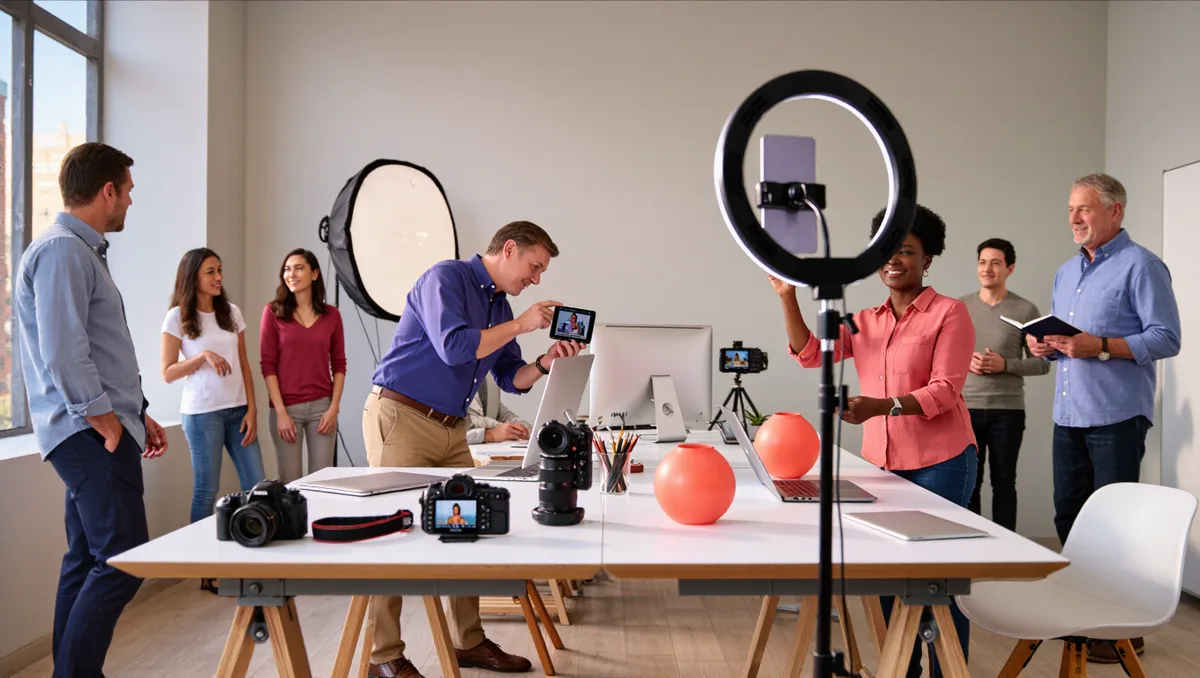
Entertainment news live coverage is the minute-by-minute reporting a newsroom publishes while an event is still happening — an award show, a red carpet, a surprise album drop. The desk writes short, timestamped updates, verifies each one before it goes up, and keeps updating the same page as the night unfolds. The most important qualification: speed never replaces sourcing, and every update still needs a named origin.
The format exists because big entertainment moments are now shared experiences in real time. Wikipedia's overview of entertainment traces how performance forms that once played to a single room grew into products for global audiences, and live coverage is the latest step of that shift. When millions watch the same ceremony at once, the live page becomes the shared second screen.
For readers, the skill is knowing what a live desk can honestly tell you at each moment — and what it cannot. That is what this guide walks through, using the Entertainment News beat as the working example.
What does a live desk actually do during a show?
A live desk is a small team assigned to one event. Before the show starts, they draft the skeleton: the running order, the likely winners, the planned photo moments. During the show, they publish short entries — often one or two sentences each — the moment something happens. Each entry carries a timestamp so readers can see exactly when the news broke.
The rhythm is write, check, publish, repeat. A writer watches the broadcast. A second person confirms what happened against a second feed or an official source. Then the update goes live. This is why a good live page sometimes runs a beat behind your own TV: the desk would rather be right than first.
You can see the output shape on any major celebrity news hub. E! Online's entertainment news feed shows the pattern in its everyday form: dozens of short, individually timestamped items, each naming who said what and where — a star's own social post, an on-air moment, a public appearance. That feed is the same muscle a live desk flexes on awards night, just stretched over hours instead of a season.
How does red carpet coverage work before the show starts?
The red carpet is a reporting assignment, not a photo call. Reporters work a fixed press line, asking a short list of questions to a stream of arrivals. Because every outlet gets roughly the same access, the desk's edge comes from preparation: knowing which nominee just released what, which presenter has a project to plug, and which star tends to give a real answer.
Live coverage from the carpet mixes three kinds of content. There is what happened — who arrived, who they wore. There is what was said — short quotes attributed to the person who said them. And there is what the desk can verify — confirmations from publicists or official feeds. What the desk cannot verify, it does not publish, or it labels clearly as unconfirmed.
Creators increasingly work this same line, and the dynamics overlap. Our guide to creators on the red carpet press line explains how that access works and what creators can and cannot do with it.
What happens when a surprise drop breaks mid-event?
Surprise drops — an unannounced album, a trailer, a casting reveal — are the hardest live assignment, because there is no running order to prep from. The desk treats them like any breaking story: confirm the thing is real, find the primary source, then publish.
The primary source is usually the artist's or studio's own account. A post from the official channel counts as on-record. A screenshot of a rumor does not. If a drop appears on a streaming service, the desk links the release itself rather than describing it secondhand. If the claim involves numbers — a chart position, a viewership figure — the desk waits for a named source, because platform metrics are only as good as their methodology, as our explainer on how streaming viewership numbers are counted lays out.
The pace matters here. A wrong item published live is hard to walk back, because readers screenshot it. Most desks would rather hold an unverified claim for two minutes than issue a correction that lives forever.
How do live desks verify fast without getting it wrong?
Verification under time pressure comes down to a simple hierarchy. First, the person's own statement — their account, their publicist, their on-stage remarks. Second, an official event or platform source: the awarding body, the streamer, the network. Third, a named second outlet confirming the same fact. Anonymous posts and fan accounts sit at the bottom and are treated as tips, not news.
Live pages also mark uncertainty in plain language. An update that says "reported" or "according to the network" is telling you the desk has one source. An update that says "confirmed" is telling you it has the primary source or two independent ones. Learning to read those labels is the single most useful skill a live-page reader can build.
There is a boundary worth naming: live entertainment coverage covers public professional life. A marriage, a health matter or a legal claim about a named person needs on-record sourcing, not a red carpet whisper. Desks that skip that rule end up issuing the corrections you remember more than the scoops.
What this means for how you should read a live page
Our analysis: treat a live page like a first draft of history that updates in public. Read the timestamps, not just the headlines. Check whether the big claims name a source. And when two live desks disagree, look for which one has the primary source attached — the artist's own post, the network's confirmation, the official winner list.
It also helps to know what happens after the event. The live page gets folded into a wrap-up story, the standout quotes get their own items, and the reaction cycle begins — fan discussion, follow-up reporting, and sometimes a whole second wave of coverage, the way fan theories keep shows alive long after an episode airs. The live desk starts that cycle; it does not end it.
The takeaway is simple. Live entertainment news is a craft with rules: timestamp everything, verify before publishing, attribute every claim, and hold the line between public professional life and private life. The best live pages make it look effortless. It is not — it is a checklist, run fast, by people who know the consequences of being both wrong and early.